
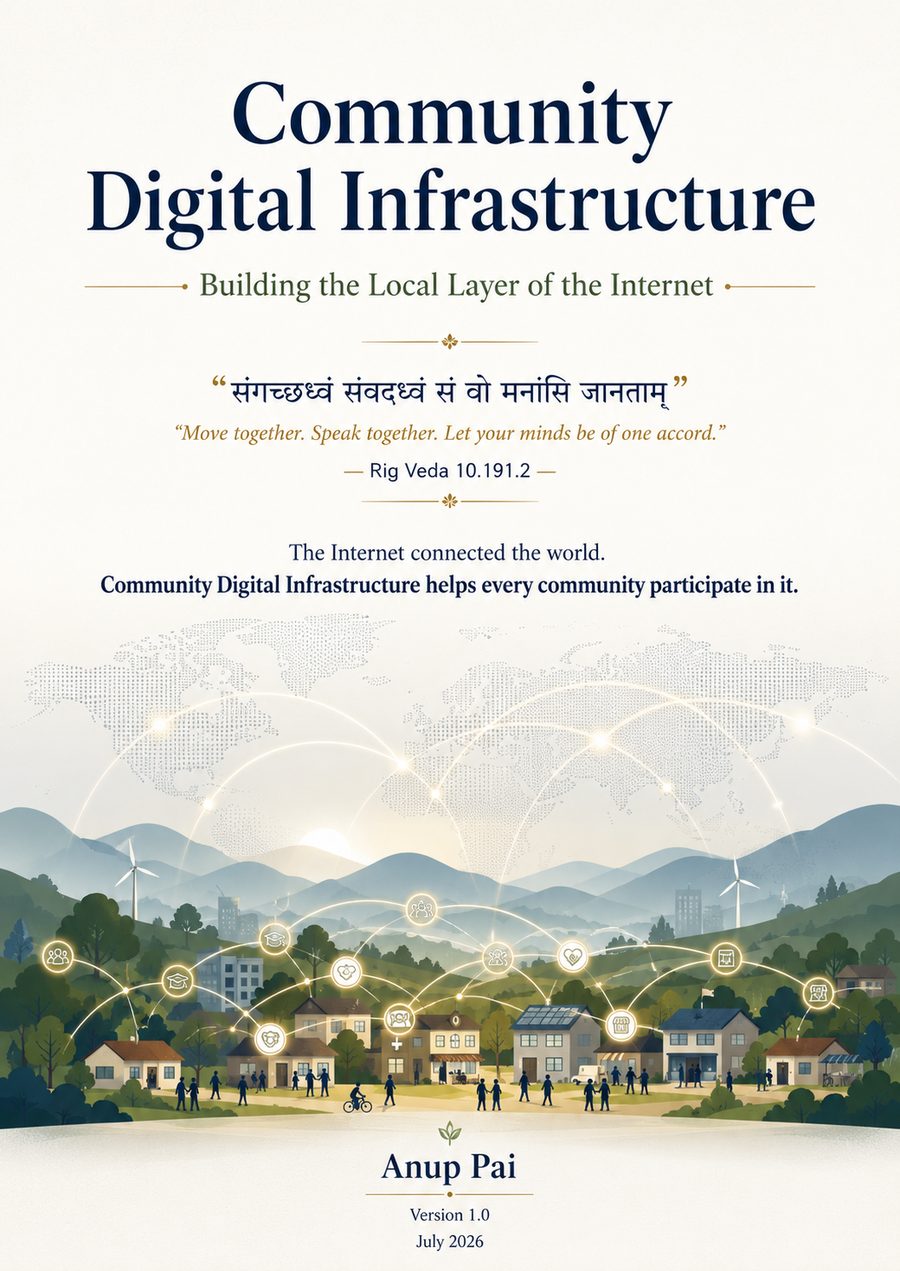
Communities are the next layer of the Internet.
The Internet transformed how humanity communicates, learns, and does business. It connected billions of people to information and to one another.
Yet one essential layer remains largely missing: infrastructure for communities.
Communities are where people build trust, start businesses, share knowledge, care for one another, and create local economies. Today, these activities depend on disconnected applications, private platforms, and informal coordination. While Digital Public Infrastructure (DPI) has modernized the relationship between citizens and governments, communities still lack a shared digital foundation for organizing economic and social life.
This paper introduces Community Digital Infrastructure (CDI)—a new category of digital infrastructure designed to help communities coordinate, collaborate, and participate in the network economy while remaining locally governed and globally connected.
We present NEST Networks as a reference architecture for building CDI. Inspired by the principles of Cloud to Ground, Nested Networks, and Combinatorial Synergies, NEST enables independent people, businesses, institutions, and local governments to work together as software-connected networks. These networks preserve local autonomy while gaining the scale, resilience, and capabilities traditionally associated with large centralized organizations.
The ideas presented here emerged from work that began in India, but they are intended to be universal. Every country has communities. Every community has productive capacity. Community Digital Infrastructure provides a common foundation for helping communities organize, innovate, and prosper together in the twenty-first century.
The Industrial Economy was built on organizations.
The Internet Age connected information and people at planetary scale.
The Network Economy will be built on coordination for communities, by communities.
Part IWhy Community Digital Infrastructure?
1. The Next Evolution of Human Coordination
Infrastructure shapes civilization.
Every generation builds on the infrastructure created by the one before it.
Roads connected places.
Electricity powered industry.
Telecommunications connected people.
The Internet connected information.
Digital Public Infrastructure (DPI) connected citizens, businesses, and governments.
Each reduced the cost of coordination and expanded what people could accomplish together.
Today, billions of people can communicate instantly, exchange knowledge globally, and participate in digital markets. Yet the Internet still lacks one essential layer: infrastructure for communities.
Communities are where people build trust, create businesses, learn skills, exchange knowledge, and solve shared problems. They are the smallest units where economic and social life naturally comes together.
Despite their importance, communities have never had digital infrastructure designed specifically for them.
Instead, they rely on messaging applications, spreadsheets, disconnected software, and private platforms. These tools help individuals communicate but do little to help communities coordinate.
As a result, much of the world's productive capacity remains fragmented.
The next evolution of the Internet is not connecting more devices or collecting more data. It is helping communities coordinate as effectively as the organizations they support.
That is the purpose of Community Digital Infrastructure.
The Economics of Coordination
Throughout history, larger organizations emerged because they reduced the cost of coordination.
Businesses brought workers together.
Governments coordinated public services.
Markets connected buyers and sellers.
The Internet dramatically lowered the cost of communication, but coordinating independent people and organizations remains difficult. Trust, governance, identity, payments, and collaboration are still managed through separate systems.
Modern software has begun to change this equation.
Shared digital infrastructure can reduce the cost of coordination without requiring everyone to belong to the same organization.
This creates the possibility of a new kind of economy—one built not on larger organizations, but on stronger networks.
The Network Economy
The Industrial Age rewarded scale.
The Information Age rewarded access.
The Network Economy rewards coordination.
In a network economy, independent people, businesses, institutions, and communities collaborate while retaining their independence.
Instead of concentrating capability inside a single organization, capability is distributed across many participants and connected through shared infrastructure.
As software reduces the cost of coordination, networks become increasingly capable of performing functions once reserved for large centralized organizations.
The challenge is no longer connecting people to the Internet.
It is helping communities organize themselves through it.
2. From Cloud to Ground
The cloud thinks globally. Communities act locally.
The cloud has become humanity's shared memory.
It stores knowledge, powers artificial intelligence, connects markets, and enables collaboration across continents.
Its strength is scale.
Communities have a different strength.
They understand place.
They build trust through relationships.
They create culture, businesses, institutions, and local economies.
Every meaningful action eventually happens somewhere.
Food is grown locally.
Children learn in communities.
Businesses employ people in places.
Governments deliver services to localities.
The cloud provides intelligence.
The ground creates value.
Neither is sufficient on its own.
The future belongs to systems that connect global knowledge with local action.
We call this design principle Cloud to Ground.
Cloud to Ground recognizes that communities should benefit from the scale of the Internet without surrendering their identity, autonomy, or relationships.
Artificial intelligence may become global.
Trust remains local.
Markets may span continents.
Communities remain rooted in place.
Community Digital Infrastructure connects these two worlds. It allows communities to participate in global networks while strengthening local collaboration.
Designing for Place
Most digital systems are designed for users.
Community Digital Infrastructure is designed for places.
Places have people. Businesses. Schools. Hospitals. Markets. Libraries. Local governments. Community organizations.
Together they create local economies.
Designing for place means recognizing that communities are more than collections of individuals.
They are living networks.
3. The Community Gap
Communities have applications. They need infrastructure.
Over the past three decades, the Internet has produced extraordinary applications.
Search engines organize information. Messaging connects people. Marketplaces connect buyers and sellers. Banks move money. Governments increasingly deliver services online.
These systems solve important problems. But they are largely independent.
A community uses many applications and owns none of the infrastructure connecting them. As a result, communities often coordinate through manual effort.
Information is copied between systems. Relationships are rebuilt from scratch. Trust remains fragmented. Collaboration depends on individual initiative rather than shared infrastructure.
Digital Public Infrastructure has demonstrated the value of building common digital foundations for society.
Community Digital Infrastructure extends this idea to communities. Instead of focusing on interactions between citizens and institutions, it focuses on interactions within communities themselves.
Its purpose is simple: make it easier for people, businesses, institutions, and local governments to work together.
Introducing Community Digital Infrastructure
Community Digital Infrastructure (CDI) is shared digital infrastructure that enables communities to organize economic and social activity.
Like roads or electricity, CDI is not an application.
It is the infrastructure upon which many applications can be built.
CDI provides communities with a common foundation for identity, trust, collaboration, commerce, and governance while remaining interoperable with existing digital systems.
Every country has communities.
Every community has productive capacity.
The opportunity before us is to provide every community with the digital infrastructure needed to participate fully in the Network Economy.
The remainder of this paper presents a reference architecture for building that infrastructure.
Part IICommunity Digital Infrastructure
4. What is Community Digital Infrastructure?
Communities need shared digital infrastructure.
Community Digital Infrastructure (CDI) is the shared digital foundation that enables communities to organize, collaborate, and create economic value.
It is infrastructure—not an application.
Just as roads support many kinds of transport and the Internet supports many kinds of communication, CDI supports many kinds of community activity.
Commerce. Learning. Finance. Governance. Healthcare. Agriculture. Tourism. Culture.
The goal is to provide a common foundation that allows them to work together, not to replace existing applications
Applications come and go.
Infrastructure endures.
The Digital Commons
Communities have always depended on shared infrastructure.
Roads. Markets. Libraries. Water systems. Parks. Schools. Public Safety.
These are commons that enable people to work together. CDI extends this idea into the digital world by providing a digital commons that communities can collectively build upon while remaining open to innovation from businesses, governments, and civil society.
No single organization owns a community.
Its digital infrastructure should reflect the same principle.
Local First. Global by Design.
Communities differ in language, culture, laws, and priorities.
Their digital infrastructure should be equally adaptable.
Community Digital Infrastructure begins locally.
Each community governs its own data, relationships, and rules.
At the same time, every community remains connected to a larger network through open standards and shared protocols.
Local autonomy and global interoperability: both are necessary.
Community Digital Infrastructure and Digital Public Infrastructure
Digital Public Infrastructure (DPI) provides common digital services at national scale.
Identity.
Payments.
Public records.
Citizen services.
Community Digital Infrastructure builds upon these capabilities by enabling communities to organize themselves using the same principles of openness, interoperability, and shared infrastructure.
DPI connects citizens with institutions.
CDI connects communities with one another.
Together they create a complete digital foundation for society.
5. NEST Networks
Infrastructure should connect communities, not centralize them.
NEST Networks is the reference architecture presented in this paper for building Community Digital Infrastructure.
Rather than creating one large centralized platform, NEST connects many independent communities through a common architecture.
Every community remains autonomous and interoperable.
Growth happens by connecting communities—not by replacing them. This is the principle of Nested Networks.
Nested Networks
Most digital platforms grow by bringing everyone into a single system.
Nested Networks take a different approach.
Communities remain independent. They establish their own rules. Their own governance. Their own relationships.
Shared protocols allow these communities to collaborate without surrendering their autonomy.
Small networks become larger networks.
Neighbourhoods become districts.
Districts become regions.
Regions become global networks.
Scale emerges through cooperation rather than centralization.
Circles
Every community exists within one or more contexts.
A neighbourhood.
A marketplace.
A cooperative.
A school.
A guild.
A professional association.
NEST represents each of these contexts as a Circle.
A Circle provides a shared environment for collaboration, commerce, governance, and trust.
Every Circle is identified by a globally unique CircleID.
CircleIDs enable communities to discover one another and interact using open standards rather than proprietary platforms.
Trust
Communities function because people trust one another. Digital systems must support this reality.
Rather than assuming a single global authority, NEST allows trust to be established by independent Trust Providers.
Different communities may choose different Trust Providers while remaining interoperable. Each Trust Provider is identified by a globally unique Trust Provider ID (TPID).
This separates identity from governance and allows trust to evolve naturally as communities grow.
A Living Network
NEST is a living network of communities connected through shared infrastructure, not a centralized application.
Every new community strengthens the network. Every new connection creates new opportunities for collaboration.
The architecture grows through participation rather than control.
6. The Local Operating System
Every locality needs a digital operating system.
Every locality already has physical infrastructure.
Roads connect people, markets support commerce, schools develop knowledge, and hospitals provide care.
Local governments coordinate public services.
Community Digital Infrastructure complements these assets with a shared digital foundation.
Together, they form a Local Operating System.
Coordinating Local Economies
Communities coordinate far more than transactions.
They coordinate relationships.
Knowledge.
Skills.
Resources.
Reputation.
Trust.
Opportunities.
The Local Operating System provides common digital services that make these interactions easier, but not by replacing existing organizations.
By helping them work together.
Building Blocks
Every locality is different.
Yet most require similar capabilities.
- Community Identity
- Trust Networks
- Digital Commerce
- Payments
- Knowledge Sharing
- Resource Discovery
- Event Coordination
- Local AI
- Governance
- Data Stewardship
These building blocks form a shared foundation upon which communities can build their own applications.
The Role of Local Government
Local governments are natural stewards of shared infrastructure.
They maintain roads, markets, parks, police stations, and libraries.
Community Digital Infrastructure extends this responsibility into the digital world.
Governments need not build every application. Instead, they can help establish and reinforce the shared infrastructure upon which communities, businesses, cooperatives, universities, and entrepreneurs innovate.
This creates a healthier relationship between public infrastructure and private enterprise.
Infrastructure remains shared.
Innovation remains open.
From Local to Global
Every locality is unique.
Every locality also benefits from participating in larger networks.
CDI enables both.
Communities remain rooted in place while becoming part of a global network of collaboration. Knowledge travels, ideas spread. Commerce expands and trust grows.
The Internet connected communities to the world.
Community Digital Infrastructure enables communities to participate in the Network Economy on their own terms.
Part IIIGrowing the Network Economy
7. Combinatorial Synergies
Software changes the economics of coordination.
The Industrial Age rewarded scale.
The Information Age rewarded access.
The Network Economy rewards collaboration.
Historically, organizations grew larger because coordinating people inside a company was easier than coordinating independent organizations.
Modern software changes that equation.
Shared digital infrastructure makes it possible for independent people, businesses, cooperatives, institutions, and local governments to work together without becoming a single organization.
This creates a new source of economic value.
We call this Combinatorial Synergies.
Many Small Units. One Large Network.
Every household has capabilities.
Every business has expertise.
Every institution has knowledge.
Individually, these capabilities are limited.
Together, they create possibilities that none could achieve alone.
CDI makes these combinations easier to discover, trust, and coordinate.
Growth comes from creating more productive relationships—not simply larger organizations.
Entrepreneurial Households
The household is one of humanity's oldest economic institutions. For centuries it has produced food, crafts, services, knowledge, and culture.
The Internet allows households to reach global markets.
Community Digital Infrastructure allows them to collaborate locally while participating globally.
An entrepreneurial household becomes more than a consumer of digital services.
It becomes a producer in the Network Economy.
Many Pals
Traditional organizations concentrate capability.
The Many Pals model distributes it.
Independent households, businesses, cooperatives, and institutions remain autonomous while collaborating through shared infrastructure. Each participant contributes what they do best.
Software coordinates the whole.
Instead of building ever-larger organizations, we build ever-more-capable networks.
Beyond Network Effects
Digital platforms grow through network effects.
The value of the platform increases as more people join.
Community Digital Infrastructure grows differently because its value comes from increasing the number of meaningful collaborations.
Every new participant creates new possibilities. Every new connection creates new combinations.
Growth becomes exponential not because everyone uses the same platform, but because everyone can work together more easily than ever before.
That is the power of combinatorial synergies.
8. Growing the Network
Infrastructure grows one community at a time.
Every great infrastructure began locally.
Roads connected neighbouring towns before connecting nations.
The Internet connected a handful of universities before connecting the world.
Community Digital Infrastructure will grow the same way.
One community.
One locality.
One region.
One network at a time- organically.
A Shared Responsibility
CDI succeeds through collaboration.
Communities create relationships. Entrepreneurs build businesses. Universities develop knowledge. Businesses innovate. Local governments steward shared infrastructure.
No single organization owns the Network Economy.
Everyone contributes to it.
Local First
Every deployment begins with one community.
It learns, adapts, and grows.
Successful communities inspire neighbouring communities.
Neighbouring communities become districts.
Districts become regions.
Regions become global networks.
Scale emerges naturally.
Open by Design
The Network Economy should remain open.
Communities should be free to choose their applications.
Businesses should be free to innovate.
Governments should be free to adopt policies appropriate to their societies.
Interoperability—not uniformity—is the goal.
Shared infrastructure should increase diversity rather than reduce it.
A Living Network
Every new community strengthens the whole network.
Knowledge spreads and trust expands.
Innovation accelerates and economic opportunities multiply.
Infrastructure becomes more valuable as communities contribute to it.
Growth is measured not only by the number of participants, but by the quality of the relationships they create.
9. Looking Ahead
The future belongs to networks.
The Internet connected computers.
The Web connected information.
Digital Public Infrastructure connected citizens with governments.
Community Digital Infrastructure connects communities.
Together, these layers create the foundation of the Network Economy.
The Network Economy does not replace governments.
It does not replace markets.
It does not replace businesses.
It enables them to collaborate more effectively.
As artificial intelligence becomes more capable and digital services become more abundant, the greatest opportunity lies not in building larger organizations, but in helping independent people and institutions work together.
Community Digital Infrastructure provides a shared foundation for that future.
The first implementations described in this paper began in India but the vision is global.
Every country has communities.
Every community has knowledge.
Every community has productive capacity.
The Internet connected the world.
Community Digital Infrastructure helps every community participate in it.
Appendix AVocabulary
This appendix defines the terms used throughout this paper. Unless otherwise stated, these definitions apply wherever the terms appear.
Community
A group of people who choose to coordinate around a shared place, purpose, profession, culture, or interest.
Communities are the fundamental social units of the Network Economy.
Habitat
The smallest place where people live, work, learn, produce, exchange value, and build relationships.
Examples include a village, neighbourhood, apartment complex, campus, market, or industrial estate.
Habitats are the building blocks of communities.
Locality
The primary unit of local governance.
Depending on the country, this may correspond to a district, county, municipality, borough, commune, parish, prefecture, or similar administrative unit.
Throughout this paper, the term locality is used in this generic sense.
District
A collection of interconnected communities sharing Community Digital Infrastructure.
The term is used as shorthand for the primary unit of local government.
Region
A federation of localities that cooperate while preserving local autonomy.
Regions enable collaboration across larger geographic and economic areas.
Community Digital Infrastructure (CDI)
Shared digital infrastructure that enables communities to organize economic and social activity.
Like roads or electricity, CDI is infrastructure upon which many applications and services can be built.
Digital Commons
Shared digital resources collectively stewarded for the benefit of a community.
Examples include identity systems, trust networks, knowledge repositories, registries, and shared data.
Network Economy
An economy in which value is created primarily through coordination between independent people, organizations, communities, and intelligent systems.
Local Operating System
The shared digital capabilities that allow a locality to coordinate commerce, governance, learning, finance, and civic participation.
Community Digital Infrastructure provides the foundation for the Local Operating System.
NEST Networks
The reference architecture presented in this paper for building Community Digital Infrastructure.
Circle
A context in which participants collaborate under a shared purpose or set of rules.
Examples include neighbourhoods, cooperatives, guilds, marketplaces, schools, and professional associations.
CircleID
A globally unique identifier representing a Circle.
CircleIDs enable communities to discover and interact with one another.
Trust Provider
An organization responsible for establishing trust, identity, and governance within one or more Circles.
Trust Provider ID (TPID)
A globally unique identifier representing a Trust Provider.
Entrepreneurial Household
A household that creates economic value through goods, services, knowledge, capital, or creativity.
Entrepreneurial households are the smallest productive units of the Network Economy.
Many Pals
A model of organization in which independent households, businesses, institutions, and communities collaborate through shared digital infrastructure instead of centralized organizations.
Combinatorial Synergies
The increase in productive capacity created when independent capabilities are combined in new ways.
Unlike traditional network effects, combinatorial synergies increase the number of possible collaborations.
Cloud to Ground
A design principle that combines global digital intelligence with local human relationships and action.
Nested Networks
A network architecture in which autonomous communities connect through open standards while preserving local governance and identity.
Appendix BDesign Principles
The following principles guide the design of Community Digital Infrastructure.
Infrastructure Before Applications
Shared infrastructure should precede individual applications.
Applications evolve.
Infrastructure endures.
Local First
Communities should retain ownership of their relationships, data, and governance while remaining globally connected.
Cloud to Ground
Global intelligence should strengthen local communities rather than replace them.
Nested Networks
Growth should occur by connecting autonomous communities instead of centralizing them.
Open by Design
Interoperability should be preferred over vendor lock-in.
Community Stewardship
Communities should participate in governing the infrastructure upon which they depend.
Human-Centred AI
Artificial intelligence should augment human communities, not replace them.
Combinatorial Growth
Economic growth should come from increasing productive collaborations rather than organizational size.
Trust by Choice
Communities should be free to choose the institutions through which trust is established.
Global Interoperability
Every community should be able to collaborate with every other community through shared standards.
Appendix CSupporting Observations
Community Digital Infrastructure builds upon several long-term trends.
- The declining cost of communication.
- Increasing digital connectivity.
- Growth of Digital Public Infrastructure.
- Expansion of artificial intelligence.
- Rise of entrepreneurial households.
- Growth of cooperative and platform-independent business models.
- Increasing importance of local resilience.
- Global demand for trusted digital collaboration.
These trends suggest that the next phase of digital infrastructure will focus on helping communities coordinate rather than simply connecting individuals.
Appendix DReference Implementations
The concepts presented in this paper are being explored through several independent initiatives.
eSamudaay
A community commerce network exploring local-first digital marketplaces and peer-to-peer commerce.
Moneypal
A financial coordination platform exploring new models of community banking, digital money, and local capital formation.
small
A locality-first platform exploring discovery, and place-based economic development.
These implementations should be understood as experiments that inform the continuing evolution of Community Digital Infrastructure. They demonstrate how shared infrastructure can support different domains while remaining interoperable through common architectural principles.
Appendix EFurther Reading
Readers interested in exploring the ideas presented in this paper may find the following subjects useful:
- The Internet and Internet Architecture
- Digital Public Infrastructure
- Community Banking
- Cooperative Economics
- Network Economics
- Transaction Cost Economics
- Complex Adaptive Systems
- Nested Networks
- Digital Commons
- Institutional Economics
- Open Standards
- Local Governance
- Artificial Intelligence
- Distributed Systems
Appendix FA Manifesto for Community Digital Infrastructure
Community Digital Infrastructure is built on a simple belief:
The future of the Internet depends on the ability of communities to organize, collaborate, and prosper together.
This manifesto is an invitation—not to adopt a technology, but to help build a new layer of civilization.
1. Communities are the next layer of the Internet.
The Internet connected people, information, and institutions.
The next step is to connect communities.
2. Infrastructure should connect, not control.
Infrastructure exists to increase freedom.
It should enable cooperation without demanding conformity, and interoperability without requiring centralization.
3. Build from the ground up.
Lasting change begins in communities.
Strong neighbourhoods create strong regions.
Strong regions create strong nations.
Strong nations contribute to a stronger world.
4. The cloud should strengthen the ground.
Global knowledge becomes valuable only when it improves local life.
Technology should deepen our connection to place, culture, and one another.
5. Every community deserves digital commons.
Just as every community depends on roads, water, libraries, and public spaces, every community deserves shared digital infrastructure that serves the common good.
Digital commons should be open, trusted, and stewarded for future generations.
6. Trust is local. Collaboration is global.
Trust grows through relationships.
Shared infrastructure allows trusted communities to collaborate across neighbourhoods, cities, countries, and cultures while preserving local autonomy.
7. Software should reduce the cost of cooperation.
The greatest contribution of software is not automation. It is making cooperation easier.
When people can coordinate effortlessly, new forms of enterprise, governance, learning, and creativity become possible.
8. Prosperity grows through combinatorial synergies.
Every household possesses knowledge.
Every business develops expertise.
Every institution contributes capabilities.
The future belongs to networks that make these capabilities discoverable and combinable in ways that create value for everyone.
9. Diversity is strength.
Communities should not become copies of one another.
Different cultures, languages, traditions. Different ways of organizing.
Shared infrastructure should make diversity easier to preserve and easier to connect.
10. Stewardship is more important than ownership.
Communities inherit infrastructure from previous generations.
They improve it. They pass it forward.
Digital infrastructure should be built with the same responsibility.
11. Build for the next hundred years.
Applications will change.
Technologies will evolve.
Artificial intelligence will transform how we work.
Infrastructure should outlast them all.
Design for openness.
Design for resilience.
Design for future generations.
Closing
The Industrial Age was built on organizations.
The Information Age connected information.
The Network Economy will be built on communities.
Community Digital Infrastructure provides a shared foundation upon which communities can learn, collaborate, create, and prosper—locally rooted, globally connected.
May every community have the opportunity to contribute to humanity's shared future.
अयं निजः परो वेति गणना लघुचेतसाम् ।
उदारचरितानां तु वसुधैव कुटुम्बकम् ॥
"The narrow-minded distinguish between 'mine' and 'others'.
For those of generous vision, the whole world is one family."
— Maha Upanishad 6.72