
Moneypal Software
Communities are the next layer of the Internet.
Moneypal Software builds Community Digital Infrastructure: the shared digital foundation that lets people, businesses, institutions and local governments work together, locally governed and globally connected.
Community Digital Infrastructure
Communities have applications. They need infrastructure.
Community Digital Infrastructure (CDI) is shared digital infrastructure that enables communities to organize economic and social activity.
Like roads or electricity, CDI is not an application. It is the foundation for identity, trust, collaboration, commerce and governance on which many applications can be built, while staying interoperable with the systems communities already use.
Connects citizens with institutions.
Common digital services at national scale: identity, payments, public records and citizen services.
Connects communities with one another.
Builds on DPI so that communities can organize themselves with the same openness, interoperability and shared infrastructure.
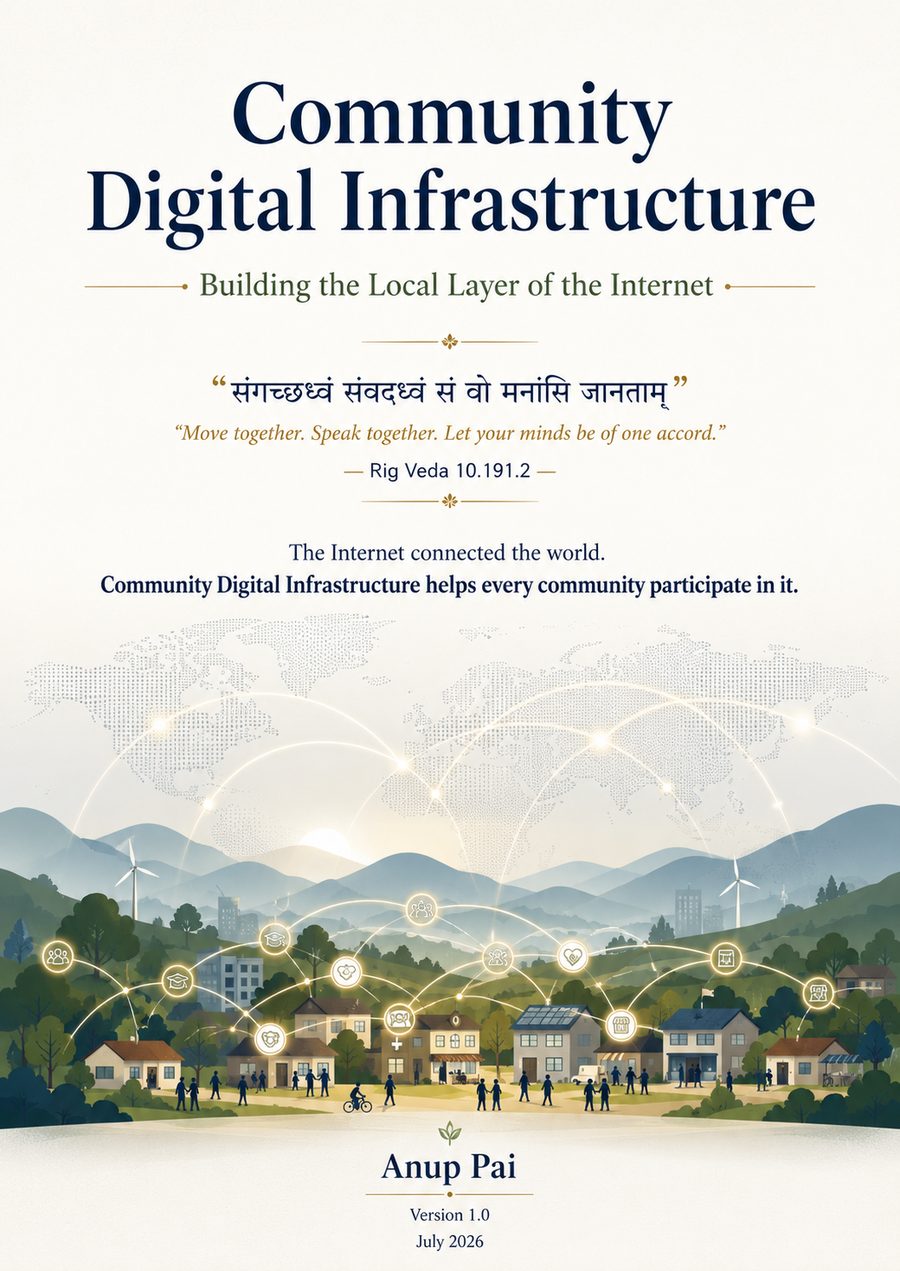
Whitepaper · Version 1.0 · July 2026
Community Digital Infrastructure: Building the Local Layer of the Internet
By Anup Pai. Introduces CDI as a new category of digital infrastructure and presents NEST Networks as its reference architecture.
Three design principles
Software changes the economics of coordination.
Cloud to Ground
The cloud provides intelligence. The ground creates value. Global knowledge should strengthen local communities, not replace them.
Nested Networks
Communities stay autonomous and connect through shared protocols. Scale emerges through cooperation, not centralization.
Combinatorial Synergies
Value comes from the number of meaningful collaborations between independent households, businesses and institutions.
NEST Networks · Reference architecture
Infrastructure should connect communities, not centralize them.
NEST connects many independent communities through a common architecture. Every community stays autonomous and interoperable.
Circles
A neighbourhood, marketplace, cooperative, school or guild is a Circle: a shared environment for collaboration, commerce, governance and trust. Each has a globally unique CircleID.
Trust Providers
Trust is established by independent Trust Providers, each with its own ID. Communities choose their provider and still interoperate.
A living network
Neighbourhoods become districts, districts become regions, regions become global networks. Growth comes through participation, not control.
The Local Operating System
Every locality is different, yet most need the same building blocks.
- Community Identity
- Trust Networks
- Digital Commerce
- Payments
- Knowledge Sharing
- Resource Discovery
- Event Coordination
- Local AI
- Governance
- Data Stewardship
How Moneypal builds it
Three layers, one institutional system.
Different people need different workbenches. They should still work on the same institutional system.
Experience
Where people do their work.
- AI Assistant
- Workbenches
- Mobile apps
- Management dashboards
Core Services
The operating system of the institution. Configure the institution before customising the software.
- Identity
- Workflow
- Jobs
- Documents
- Evidence
- Consent
- Audit
- Integrations
Genesis Intelligence
Turns institutional activity into institutional intelligence.
- Data
- Institutional memory
- Analytics
- Knowledge retrieval
- Learning loops
AI that augments people.
AI analyses, recommends, summarises and amplifies capability.
Humans stay in command.
People keep judgement, decisions, relationships and accountability.
First product
From Core Banking to Coherence Banking.
Banking infrastructure for the post-AI world, built for banks, NBFCs and corporates whose legacy core systems are under pressure.
Core Banking
- Transaction-centric
- Product-centric
- Fragmented context
- Periodic reporting
Coherence Banking
- Lifecycle-centric
- Institution-centric
- Evidence-centric
- Shared context and institutional memory
- AI-assisted intelligence
- Continuous learning
Coherence Banking runs on the same identity and trust layer that verifies businesses across Moneypal Trust Networks.
Who it is for
Everyone who shares responsibility for a local economy.
Banks, NBFCs and corporates
One shared context across underwriting, risk, compliance and operations, through Coherence Banking.
Local governments
Natural stewards of shared infrastructure. Establish the digital commons on which communities and businesses innovate.
Cooperatives and communities
Run as a Circle with your own rules, governance and relationships, connected to a larger network.
At the centre of all of it is the Entrepreneurial Household: the smallest productive unit of the Network Economy, and a producer in it, not only a consumer of digital services.
Reference implementations
The ideas are being tested in live networks.
GICC
A community banking institution lending to microenterprises, start-ups, farmers and individuals in underserved communities.
giccltd.com →Moneypal
A financial coordination platform exploring new models of community banking, digital money and local capital formation.
small
A locality-first platform exploring discovery and place-based economic development.
small.mp →How we work
Infrastructure grows one community at a time.
- Start with one community and a real problem.
- Configure the institution.
- Build the first workflow.
- Deploy to real users.
- Learn from usage.
- Improve the framework.
- Productise reusable capabilities.
- Connect the next community.
Contact
Talk to Moneypal.
Tell us about the institution or community you serve and the problem you want to start with.